Node Types
This section describes the different node types used in the Freifunk Parker network from Freifunk Braunschweig.
Concentrator
The concentrators provides persistent storage functionalities for the network and routes traffic from its connected clients to an exit node. The concentrator provides the configuration for the client node type via the etcd service.
Exit
Exit nodes are the edge nodes which provide internet access to the FFBS network. They use Freifunk Rheinland as the exit network and need to provide NAT for this service.
Client
Client nodes provide network access to the end users. This is done either via a wireless service as an AP or to a local LAN via a seperate ethernet port on the node. Client nodes are usually embedded wireless routers flashed with the FFBS firmware.
FFBS network diagram sample
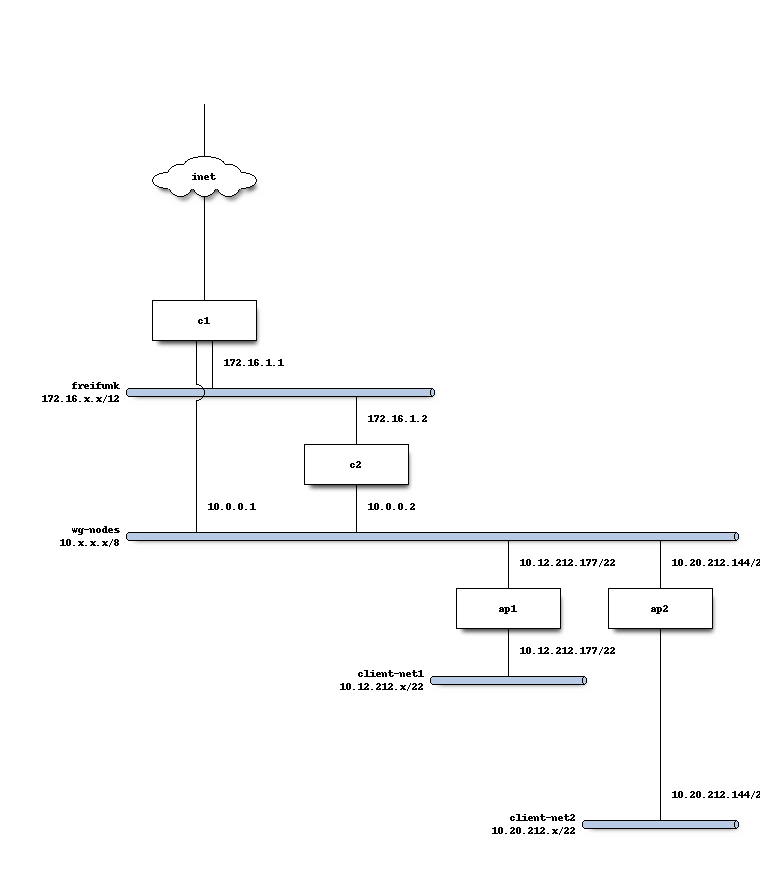
The diagram shows a minimized cutout of the Freifunk Braunschweig Parker network
architecture. Internet is provided to the c1 node via Freifunk Rheinland via a
GRE tunnel. The freifunk network as displayed above is not a physical
connection via a network switch and instead consists of wireguard tunnels
between the concentrator nodes (c1, c2) in the above diagram.
The c1 node provides NAT for the ipv4 network traffic in the infrastructure.
The wg-nodes network is also not a physical link and instead consists of the
client access point creating a wireguard link to two different concentrators.
This is useful since the infrastructure can steer access points between
concentrators and these can switch to the backup link to a different
concentrator without requesting a new configuration.